Gary Harrell
Black Hawk DownGary Harrell, a lieutenant colonel and mission commander, occupies a difficult position between the larger operation and soldiers trapped in the streets of Mogadishu. As the fight around Cliff Wolcott’s downed Black Hawk helicopter intensifies, he tries to improve the soldiers’ ability to support one another, presses for help for critical casualties, and ultimately declines to settle a dispute that he believes belongs to the commander on the ground. His role is defined by the limits as well as the reach of command: he can see the danger and argue for action, but cannot make the surrounding forces or rescue resources arrive at once.
Position and View from Above
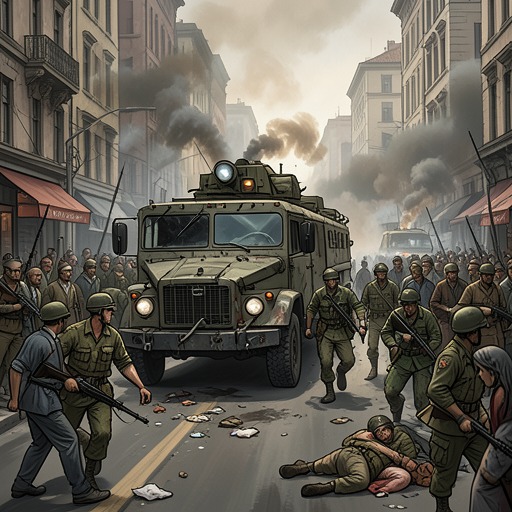
As darkness fell, 99 men were scattered through the narrow streets around the crash site. Harrell circled high over the city in a Black Hawk helicopter while the commanders below debated how to position their forces. The airborne perspective gave him a view of the operation as a whole, but the immediate choices belonged to men taking cover in courtyards and buildings under fire.
Harrell supported Capt. Scott Miller’s proposal to gather the separated soldiers at one location near the crash site. He argued that concentration would allow them to establish more effective crossfire zones and give the helicopter gunships a better opportunity to engage the gunmen surrounding them. The Little Bird helicopters were already making gun runs, their miniguns raining brass links down on the fighters. Harrell’s request was practical: bring the men together, and establish a single person on the ground to communicate with him. The proposal sought to make a fragmented force easier to coordinate and support from above.
The Dispute over Moving the Rangers
Capt. Mike Steele, the Ranger commander, was reluctant to move the men with him a block north to join Miller. Harrell encouraged him to try to assemble everyone at one site, but did not treat his own view as a substitute for the decision Steele had to make. After Steele asked him to resolve the dispute, Harrell declined to choose between the captains. He told them that if they remained separated he could not support them as effectively, but that the commander on the ground had to make the call.
That answer left the disagreement unresolved at the higher level. Miller believed his men were in charge on the ground; Steele did not accept Miller as his superior and wanted Harrell to decide. Harrell instead identified both the operational cost of staying apart and the boundary of his own authority in that moment. Steele chose not to move. The exchange shows Harrell seeking a coordinated position without issuing a decision that would erase the ground commander’s responsibility for the risks of moving men through exposed streets.
Efforts to Evacuate the Wounded
Harrell’s command role also brought him into the struggle to get the wounded out. When Larry Perino reported that Jamie Smith was worsening and needed a doctor and hospital, Steele asked Harrell to put a helicopter down in the wide intersection outside his doorway. Harrell was not encouraging: the resupply helicopter had been badly shot up and had barely escaped, despite only hovering rather than landing. The request therefore confronted him with a direct limit on air support, not simply a question of whether to dispatch an available aircraft.
Harrell nevertheless pressed the case for urgent relief with the Joint Operations Center at the airport base. He emphasized that Smith and Carlos Rodriguez, who had been shot in the groin, were in critical condition, and asked about the quick reaction force still being assembled to drive into the city. His warning was specific: without the force arriving soon, men already wounded could die. The distinction mattered in a situation where casualties were accumulating faster than evacuation options could be arranged.
The answer from command was that no helicopter would attempt a landing and that the soldiers would have to wait for the armored convoy, which needed at least another hour. Rescue convoys had already failed, the other crash site—where Mike Durant’s Black Hawk had gone down—had been overrun, and Aidid’s forces had obstructed the roads leading to Wolcott’s crash site with trenches and burning barricades. Harrell relayed the decision to Steele: they would have to hold as best they could with their casualties and hope the ground reaction force arrived on time. Steele passed Perino the bleak conclusion that it was too dangerous to attempt the landing.
Command under Constraint
Harrell’s decisions are presented through urgent radio exchanges rather than a private account of his thoughts. The contrast between his elevated position and the soldiers’ immediate exposure is central to the portrait: he can advocate for a unified defense and make the condition of wounded men heard at the airport base, yet neither recommendation can remove the danger of moving on foot or make a landing safe. His refusal to decide the dispute between Miller and Steele is not indifference to their predicament; he states plainly that separation limits his ability to support them, then assigns the call to the officer on the ground.
The episodes define a commander working through imperfect options. He seeks concentration around the crash site for tactical support, requests urgent reinforcement as casualties worsen, and passes on the decision to wait when a helicopter landing is judged too dangerous. The account does not give Harrell a personal resolution beyond these exchanges. Instead, his significance lies in the command problem they expose: coordinating a scattered force and trying to preserve wounded men when communications, authority, air access, and the routes into the city are all under pressure.